Visit Batgoods.com for an expanded selection of bat merchandise, where 5% of every sale can be donated to your choice from several bat conservation organizations.
By Marian Taylor. Explores bats and their fundamental role in our ecosystems through lavish full-color photographs and lively narrative. From the Giant Golden Crowned Flying Fox, a megabat with a wingspan of more than five feet, to the aptly named Bumblebee Bat, the world's smallest mammal, the number and diversity of bat species have proven to be both rich and underestimated. Nocturnal, fast-flying, and secretive, bats are difficult to observe and catalog. This richly illustrated handbook presents bats' evolution, biology, behavior, and ecology. It offers in-depth profiles of four hundred megabats and microbats and detailed summaries of all the species identified to date. Complete with an introduction exploring bats' natural history and their unique adaptations to life on the wing, Bats includes close-up images of these animals' delicate and intricate forms and faces, each shaped by evolution to meet the demands of an extraordinarily specialized life. Hardcover, 400 Pages.
The island of Palawan, in the Philippines, conceals an extraordinary subterranean treasure: the Puerto Princesa Underground River, or Natuturingan, as the locals call it. This immense cave has been a UNESCO World Heritage Site since 1999, and since 2012 it has been listed as one of the "New7Wonders of Nature".
It plays host to an underground river that traverses the mountain from one side to another, and which flows out just a few yards from the South China Sea. It features an exceptionally rich eco-system, encompassing hundreds of animal species, many of which are native, and a food chain based on the guano generated by gigantic colonies of swiftlets and bats. One of the most popular caves in the world for tourists, Natuturingan retains intact its ancient fascination thanks to far-sighted management: no lighting has been installed inside, no passageways have been paved, and no jetties have been built on the beach. Using small outriggers, visitors can sail for around one mile into the breathtaking flooded galleries. But the cave also includes numerous other chambers, some of which are colossal in scale. Here, immersed in the silence of time, there are mineral formations of quite stunning beauty.
Over the past thirty years, the La Venta group has made a crucial contribution to the efforts to explore and document this cave. La Venta's longstanding input is at last charted in this book, which gives everyone an insight into what is one of our planet's most extraordinary underground. by Antonio De Vivo, Paolo Forti (Editor), Leonardo Piccini (Editor)
One afternoon, eleven-year-old Titan, his friends from the Wild Boars soccer team, and their coach rode their bikes to explore local caves. They crawled through the narrow tunnels in the dark to reach the center of the cave. When they turned to go home, heavy rains had flooded the tunnel. They were trapped!
With rising waters and monsoon season upon them, time and oxygen were running out. The world watched with bated breath as rescuers from around the globe joined forces to try to free the boys. After eighteen harrowing days, in an unprecedented effort of international teamwork, they were finally saved.
Award-winning author Susan Hood and journalist Pathana Sornhiran based this picture book on Sornhiran’s first-hand reporting of the event, and Dow Phumiruk’s beautiful illustrations bring the story to life. The book also includes a timeline. Ages 4-8, 48pp, HB.
How did the idea of the project Lights in the Darkness came up? It all started in 2015, during a cave photographer meeting in Turkey, when Leda Zogbi gave a presentation about the Brazilian caves. Several photographers, among the most renowned in the world, were interested in coming to Brazil to meet and photograph our caves. This movement eventually generated the project called “Lights in the Darkness”. First shipment and results The first expedition took place in July 2016. 5,500 km were covered by 4 Brazilian states: São Paulo, Minas Gerais, Goiás and Bahia and the result was a beautiful 300 pgs, colorful book in four languages (Portuguese, English, French and Spanish), 8 short videos with the making-of of the expedition that can be seen on this site, and a virtual exhibition.
The book was released in July 2017 in Australia during the International Caving Congress, and later in Brazil (Sao Paulo and Belo Horizonte) and France, where the making-of videos participated in the international Spelimages contest, which selects the best Cave movies of the world. The virtual exhibition was presented in June 2018 at MM Gerdau - Museum of Mines and Metals in Belo Horizonte for 20 days, and generated a lot of interest by the museum's public.
Caves and other subterranean habitats with their often strange (even bizarre) inhabitants have long been objects of fascination, curiosity, and debate. The question of how such organisms have evolved, and the relative roles of natural selection and genetic drift, has engaged subterranean biologists for decades. Indeed, these studies continue to inform the more general theory of adaptation and evolution. However, interest in subterranean biology is not limited to questions of evolutionary biology. Both the distribution and the apparent ancient age of many subterranean species continue to be of significant interest to biogeographers. Subterranean ecosystems generally exhibit little or no primary productivity and, as extreme ecosystems, provide general insights into ecosystem function. Furthermore, the simplicity of subterranean communities relative to most surface-dwelling communities makes them useful model systems for the study of species interactions such as competition and predation, as well as more general principles of ecosystem function. The rarity of many cave species makes them of special interest in conservation biology. by David C. Culver, Tanja Pipan, 2019, SB. 336 pp.
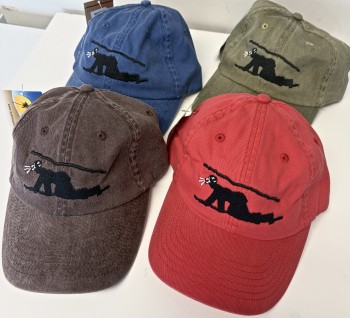
Back design with crawling caver logo front left chest. Graphite colored unisex performance shirt. 100% polyester interlock with moisture-wicking and UV protection. Perfect for before, after and during caving; or any sports or outdoor activities. Cationic dyes to ensure superior brightness and excellent color fastness.
Back design with crawling caver logo front left chest. Burgundy colored unisex performance shirt. 100% polyester interlock with moisture-wicking and UV protection. Perfect for before, after and during caving; or any sports or outdoor activities. Cationic dyes to ensure superior brightness and excellent color fastness.
Based on a popular website, this book illustrates, with 580 color photos, 46 different types of formations found in caves, from the most common to some rather uncommon. Basic text explanations are complimented by images of some of the world's most stunning examples of those formations.
Dave Bunnell, a widely published cave photographer, draws on over 40 years of images from caves in some 25 states and 18 countries. Some of the world's most pristine and decorated caves provided source material for the book, such as Lechuguilla Cave in New Mexico, the blue and green caves of France, and the giant caves of Laos and Vietnam with their massive formations.
With this book you will be able to understand how the features found in caves are formed and how they relate to each other. Introductory sections focus on the diverse and often spectacular surface phenomena associated with caves known as karst, and on different types of caves and how the form.
By Dreybrodt and Loveridge. 87 pp. Over twenty-seven kilometres of caves passages from 98 new caves are described in this volume, representing the results yielded by the five most recent expeditions to the Southern Shan State (to Pinlaung, Hopong and Ywangan areas) as well as two expeditions to the Kayah State. Includes the new deepest cave of Myanmar (Ju’s Gu, over 300 m deep) as well as many new entries to the list of longest caves of the country.
78 pp., colour photo tables, many maps & surveys; Berlin 2018. This volume presents a 2017 US expedition to Kampot Province in southern Cambodia as well as an international expedition in 2018, which continued the 2017 investigations in Phnum Proek District (Battambang Province). Sixty-two new caves and 9.9 km of passages were mapped, including the new third longest cave of Cambodia (Roung Heyndan 5 at 1,577 m). Roung Dei Ho-Thom Ken was extended and again became the longest of the country (2,036 m). The biospeleological findings of the 2018 expedition are also presented. In English with a German and a French abstract.
By Trevor Shaw, 2018. The cave Škocjanske jame has a long history of which the relatively short period between the two World Wars is the subject of this book. The area had just been transferred from Austria to Italy. Most of the cave had been explored before 1914 so the objective in the 1920s and 1930s was mainly to develop it as a tourist cave. Visitors had been accepted earlier but the emphasis now shifted to developing the tourist route through the cave, with new bridges and pathways as well as a new tunnel to the surface. The need for all arrangements to be formalized under Italian law caused problems and the re-opening of the cave to the public was delayed until 1923. Besides this development work, some exploration took place, new surveys were made and there were scientific studies. A little-know fatal accident is reported. Throughout the whole period the personalities of the individual guides, explorers and managers lead to a very human story as well as an exciting one. What helps to make this book so significant is the immense input from Italian archives, archivists and historians.
Preface
Acknowledgements
1 Introduction 2 Problems of Changing Nationality 3 Development as a Tourist Cave in the 1920s 4 Further developments, in the 1930s 5 Exploration by Austrians in 1921 & 1922 6 Federico Prez in 1922 7 Bertarelli’s Exploration in 1923 8 Surveying in Škocjanske jame 9 Images of the Cave – Models, Paintings & Photographs 10 Postal System and Postcards
Appendix: Equivalent Place-Names in Italian, German & Slovene
The karst regions of Slovenia, like those in many other parts of the world, result from the rock being limestone which is slightly soluble in rainwater. This not only causes a lack of surface streams and the presence of caves and underground rivers, but also other features characteristic of karstic landscape. In particular, solution of intersecting fissures in the rock results in cone-shaped depressions – dolines – in which some residual soil collects, and more is sometimes added by farmers to allow cultivation. Bigger, often vertical-sided depressions called collapse dolines result when the ground surface collapses into caves or cavities formed by underground streams. Collapse dolines include the immense pits at Škocjanske jame.
What is unusual about Slovenia is the amount of karst terrain that it contains. 43% of the whole country is karst; and of the part of Slovenia which was the old Austrian region of Carniola or Krain (Gorenjska, Dolenjska and Notranjska, including the Postojna area), 69% is karst.
The caves and spectacular features of karst have for centuries appealed to visitors and travellers, as they do to tourists today. For much the same reasons they have appealed to artists whose desire was to capture the scenes for themselves and for posterity.
Over the last two centuries or so we have become more and more accustomed to images of the real world. In modern times natural history films have become almost a substitute for the real thing. Personal cameras record what we have seen, sometimes more reliably than our memories, and magazines as well as television provide accurate pictorial information.
But it was not always so. Some five and a half centuries ago, printed books began to appear, providing information for those who could read. At first very few were illustrated, but about 430 years ago Valvasor was already producing his book on the castles of the province of Krain, illustrated with copper engravings; and ten years later, in 1689, there appeared his great topographical book on Krain, containing 535 illustrations. Painters of course did not depend on books to have their paintings displayed. But in later times their work was reproduced in books and reached a much wider audience.
At the same time, as technical developments made such reproduction easier and cheaper, the population increasingly learned to read. Poverty overall reduced and more people were able to enjoy leisure. This, with education, allowed them to use books and to see pictures other than those in the stained glass windows of churches.
This broadening of the kinds of readers, as well as an increase in their numbers, led quite early in the 19th century – only two centuries ago now – to the appearance of popular illustrated books aiming to arouse and satisfy curiosity. Titles such as The Wonders of Nature and Art (1803) and The Hundred Wonders of the World (1818) make this clear. Such books often include cave descriptions, many of them illustrated, and it was in this way that people living in non-karst regions became aware of the existence of caves.
So much for generalizations and context. What did all the images aim to do? One or more of the following, surely: to express the impressions, emotions and feelings of the artist; to inform people about caves and karst features; to give pleasure, by beautiful paintings or by luxurious albums of engravings; to illustrate texts (travel books, regional descriptions and guidebooks, scientific studies, accounts of cave exploration, historical studies, studies of cave images); to publicise particular caves and to advertise an unrelated product by an attractive picture.
Whilst scientific or geographical studies may require images of little-known caves or phenomena, it is clear from the content of this book that certain caves were more often the subject for artists and photographers than others. Several factors are responsible for this. Clearly an attractive cave, as the very word denotes, attracts more attention. A picturesque scene attracts pictures. And such pictures attract purchasers.
Also relevant is the extent to which the cave or place is already known. The better known places will be visited by more artists and photographers, and by more potential purchasers. Purchases, of course, include not only individual images but also illustrated guidebooks.
Another factor besides picturesque beauty affected this popularity of a place, especially before the motor car became widely available. That was its location and ease of access for large numbers of people. For Slovenia, many potential visitors were to be found at Trieste (as a major part where they waited for their ships) and on the main routes such as the vital road from central Europe through Postojna to the coast. Hence the popularity of Vilenica, Škocjanske jame and Postojnska jama. They attracted the artists and photographers, and they also attracted the visitors who would buy their productions.
Among the many cave images known, some (only a few, but nevertheless some) do provide information that is historically important. Dress is necessarily shown wherever there are people. That of the visitors is normal for the period and sometimes it is the dress that helps to date the image. Images of cave entrances necessarily record whatever barriers, gates, seats or buildings that were present at the time.
The earliest images of karst features occurred on 16th century maps, where the land was represented, not by accurately surveyed rivers, roads and contour lines, but by pictorial representations. Some of these were symbolic, such as trees for forests and little hills for mountainous county. But special features (and Cerkniško jezero was certainly considered very special) were drawn individually and the space required for this gave them extra prominence.
Individual pictures were sold for display, as indeed they still are. Such engravings were sometimes published together in albums, with or without text, as fore-runners of modern coffee-table books. The emphasis there was on attractive images, whereas later in the century pictures were used to illustrate points made in the text, for example in the books of Martel and Kraus or to illustrate places described in guidebooks.
Engravings, where the artist’s image was redrawn by the engraver on a metal plate (or lithographs where it was redrawn in stone) were still used to illustrate books and magazines up the 1890s. In that period the “artist’s image" to be engraved was often a photograph. Only when the half-tone process was developed in the 1880s, was it possible for photos to be transferred mechanically to paper in large quantities without an intermediate process.
In those earlier days (1870s to 1890s) photographs were usually engraved for publication. But the reverse also occurred. Photographers realized that cave pictures were saleable, but they found also that they were very difficult to take.
Copying was not only done to facilitate reproduction of images. It also occurred, without acknowledgement, when the easiest source for a new (saleable) illustration was an earlier one. In book publication (and ship capture) this is termed piracy. It was common in the 19th century and several examples are exposed in this book.
Of course, cave images of quality continued to be made after the cut-off date for this book – the start of World War I and the end of Slovenia’s time as part of Austria. Photographers include Friedrich Oedl (1894-1969) at Škocjanske jame in 1921, Franci Bar (1901-1988) in many caves, and several members of the Društvo za raziskavanje podzemskih jam. All those photographers were cave explorers themselves. Painters of this later period include Leo Vilhar (1899-1971); Mario Vilhar, his son (born 1925), and Lojze Perko (1909-1980). By Trevor Shaw and Alenka Cuk, 2012.
21 by 21 inch bandanna with a flight of custom printed bats. 100% cotton. Use for decoration, full head scarf, halter tops, quilt fabric or even dress your favorite pet! Assorted colors will be a mixture of colors & styles.
70 pp., colour photo tables and maps, many surveys; Berlin 2018. The Krong No Volcanic Geopark hosts the longest lava cave of SE Asia (C7 Cave at 1,067 m) and also most of the other long pyroducts of SE Asia. This volume compiles all the caves known from the Geopark to date and describes 49 caves with a total of passages of 10.1 km. There are also biospeleological remarks, an up-to-date summary on the speleogenesis of lava caves and a chapter on the archaeology of the Krong No caves. In English, with a Vietnamese, French, and German abstract.
21 by 21 inch bandanna with a flight of custom printed bats. 100% cotton. Use for decoration, full head scarf, halter tops, quilt fabric or even dress your favorite pet! Assorted colors will be a mixture of colors & styles.
21 by 21 inch bandanna with a flight of custom printed bats. 100% cotton. Use for decoration, full head scarf, halter tops, quilt fabric or even dress your favorite pet! Assorted colors will be a mixture of colors & styles.
The Natural Bridges have become one of the most popular attractions of California's Calaveras County. These two caves were formed by a process distinctly different from most caves, as chronicled in the chapter by Geologist Bruce Rogers, and shown on detailed surveys made by the first two authors. They have been attracting visitors since the days of the Gold Rush, and the fascinating history of those days of yore are chronicled in a historical writeup by historian Daniel Snyder, complete with rare illustrations of the Bridges. The main section consists of over 60 full color images of the Bridges taken by Dave Bunnell, a professional cave photographer, who resides in the local area. Many of these full page images use multiple flash techniques to fully illuminate the dark interiors of the caves. A three-page guide to the Spring flowers found along the trail rounds out the book. By David Bunnell, Daniel Snyder and Bruce Rogers. SB, 72 pp.
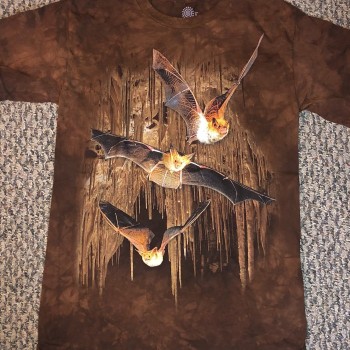
We put bat species in the spotlight with these beautifully screen printed shirts. Each species featured in the series is shown on a dashboard with information on diet, weight, lifespan, range and the scientific name. On 100% cotton preshrunk tee shirts. Large front design. The Pallid Bat (Antrozous Pallidus) is on a charcoal grey shirt.
96 pp., colour photo tables, many maps & surveys; Berlin 2017.
This volume replaces volumes 36 and 62 of this series. About 50 caves with a total of nearly 8 km of passages are presented in detail. Includes the Mbenaltembe Cave System, at 2,380 m the currently longest cave of Gabon. Also, a presumably old rock art cave site is described. In English and French, with a German abstract.
101 pp., colour photo tables, many maps & surveys; Berlin 2017.
This volume replaces volumes 6 and 12 of this series and describes the longest caves known in Iran so far. Ghar Katalehkhor is featured with a detailed survey showing 12,860 m. The same applies to Ghar Alisadr (11,440 m) which is one of the most visited show caves in the world. A number of caves in the surroundings of Ghar Alisadr are also described. In English.
Michael Laumanns: 125 pp., colour photo tables, many maps & surveys; Berlin 2017.
This volume replaces volumes 2, 3 and 62 of this series. About 100 caves with a total of 10 km of passages are presented in detail. This is the only comprehensive source of speleological data on Mozambique. Longest cave is Codzo River Cave at 942 m. In English with a German, Portuguese and French abstract.
1995 by Anne and Vernon Atkinson. With a supplement on Hawaiian Volcanoes which illustrate some of the features from Undara. Many photos and illustrations.
53 Minute DVD, 2017. Produced by Edward Frank and Phoebe Freer. In 1838 three slaves were brought to Mammoth Cave to work as guides: Stephen Bishop, Materson Bransford, and Nick Bransford. Stephen Bishop became the greatest American Cave explorer who ever lived. He crossed what was known as the Bottomless Pit and discovered tens of miles of new passage in what is known now as the longest cave in the world. The trio spent a lifetime leading tours and exploring new passages in the cave. Many other black individuals have made major contributions to the history of the cave over the years. Leading tours in the cave and exploration became a family tradition for generations of guides both black and white. For example, the Bransford family has had five generations work as guides in the cave from Mat Bransford, one of the original three slave guides, to his great great grandson and present day guide Jerry Bransford. This is their story.
Hand made in the Philippines. Fun, happy and a very bat friendly message. A two and a quarter inch long bat can be used as a key chain, pack or pouch ornament, or attached to anything you wish.
83 pp., colour photo tables, many maps & surveys; Berlin 2017. Michael Laumanns & Nancy Pistole (Eds.): International Speleological Project to Cambodia 2017 (Provinces of Siem Reap, Banteay Meanchey, Odda Meanchey and Battambang). The first systematic speleological investigations in the Cambodian province of Siem Reap (Phnom Kulen National Park). New longest cave of Cambodia, La Ang Khchal (1,960 m) near the Thai border in Battambang province. Altogether 8.1 km of cave passages from 54 caves are presented in detail. In English with a German and a French abstract.
362 pages, zillions of cave descriptions, cave surveys and maps; Berlin 2017. The "Yellow Pages" of caving in Africa. New longest cave of Africa. Each country is presented in detail including maps (e.g. topography, geology and karst occurrences) as well as a description of the geological settings, the history of speleological exploration, a detailed list of the longest and deepest caves (incl. surveys), a list of useful addresses and an in-depth bibliography. Vol. 68 covers: Introduction and Algeria to Madagascar (184 p.). Vol. 69 covers: Malawi to Zimbabwe and General Ref's (178 p.). In English. With German & French abstracts in vol. 68.
Bat outline in cut metal with smooth rust colored "rustic" finish. Three and three quarter inch wingspan. With a matching eight inch chain and connetor.
A set of 9 images on glossy five by seven inch note cards. Blank inside. Inconic images from various artists produced by Urs Widmer for Speleo Projects. Sold as 10 packs with nine images different cards plus one duplicate image. These do not come with envelopes. The cards take a standard A7 5 1/4 by 7 1/4 envelop.
A high quality 100% cotton pre-shrunk t-shirt. Seven realistically illustrated, colorful North American bats together: Brazillian Free-tailed Bat, Hoary Bat, Eastern Pipistrelle (Tri-colored bat), Big Brown Bat, Pallid Bat, Red Bat and Rafinesque's Big-eared Bat.
Each pendant is handmade using various colors of glass and feature a central bat set on a black background made of 22 karat gold. The cord lenth is approximately 18 inches and features a coordinated clasp. Offered in two basic glass colors, brown or blue. Each slightly different, some have other accent colors. Examples shown are typical but every pendant varies.
Minnesota's caves have a deep history. Carver's Cave is the first to be described in the literature of North America after explorer Jonathan Carver visited it in 1766. The storied Fountain Cave was the birthplace of the city of St Paul.
Just after the American Civil War, Chute's Cave inspired an elaborate hoax regarding an ancient civilization. Folklore surrounds Petrified Indian Cave, where a strangely shaped stalagmite was mistaken for a person turned to stone. Geologist Greg Brick, PhD, uses decades of research to uncover the secrets of geological wonders. 145PP & BW images.
By John Benton, Bill Napper, Bob Thompson. 202 black And white images. 128pp. Sb. Collins was a Kentucky cave explorer who was trapped for more than two weeks during the winter of 1925 in a cave located within the boundaries of what is now Mammoth Cave National Park. Collins had no fear of exploring the most difficult cave passages, and few people could match his persistence and endurance. The story of Floyd Collins becoming trapped, then buried alive, and ultimately dying alone in a cave held a powerful grip on the hearts and minds of people the world over. The resulting media coverage put Mammoth Cave on the map and helped usher the actual designation of Mammoth Cave as a national park.
Edited by: Howard P. Whidden (East Stroudsburg University), DeeAnn Reeder (Bucknell University), with Cal Butchkoski and Greg Turner (Pennsylvania Game Commission). Pennsylvania has long been an active center of research on bats, and in recent years Pennsylvania biologists have played leading roles in responding to the emergence of wind turbinesand White-nose Syndrome as major new threats to bats. This volume takes stock of the status of Pennsylvania's bats at a time of conservation crisis. Chapters in the book describe the natural history of Pennsylvania's bats, the history of bat research in the state, summarize long-term data on the state's bats, assess the recent impacts of wind turbines and White-nose Syndrome on the state's bats, and provide guidelines for future conservation efforts aimed at protecting and managing the state's bats. A compilation of work worth reviewing and having for reference in many areas outside Pennsylvania with similar species of bats and common issues related to the bats conservation and ecology covered. If one or more of these guides are ordered alone, total shipping charge will be $3.50. Quoted shipping (as shown on your shopping cart) will apply if combined with other goods. Otherwise, the actual shipping charge made to your card will be reduced when your order is filled and charged.
97 pp., colour photo tables, many maps & surveys; Berlin 2016. The first systematic speleological investigations in the Cambodian provinces of Stoeng Treng, Banteay Meanchey and Kampong Speu. Also describes 2 caves from a briefly visited new caving area in NE Battambang near the Thai border. Seventy-four new caves and one presumably old rock-art site (altogether 4.6 km of cave passages) are presented in detail. Includes an up-to-date article on cave bat conservation in Cambodia. In English with a German and a French abstract.
By Michael Laumanns & Liz Price. 335 pages, hundreds of cave descriptions, cave surveys and maps; Berlin 2016.
The "Yellow Pages" of caving in SE Asia. Each country is presented in detail including topographic and karst occurrence maps as well as a description of the geological settings, the history of speleological exploration, a detailed list of the longest and deepest caves (incl. surveys), a list of useful addresses and an in-depth bibliography. Hundreds of cave surveys and cave descriptions. Some countries also have maps showing the administrative divisions and other relevant thematic maps. Vol. 65 covers: Introduction & Brunei-Malaysia (168 p.). Vol. 66 covers: Myanmar-Vietnam (167 p.). In English. With German and French abstracts.
BY Herbert Daniel Gebauer. 102 pp., colour photo tables and maps, many surveys; Berlin 2017.
Sixty-one caves are presented in this volume in detail, including Pielkhlieng Pouk which was so far surveyed to a length of 9,660 m and explored to over 12.6 km. Many of these caves are not fully explored yet. Twenty-seven caves not yet visited are mentioned, emphasizing the cave potential in the Khaddum area for future explorers. In English language.
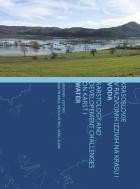
This bilingual scientific monograph with many illustrations presents the Velika Pasica cave, located on the outskirts of the Gornji Ig village on the Krim massif, around 20 km south of Ljubljana, Slovenia. The book presents ecological, taxonomical and biodiversity studies, as well as morphological and historical facts referring to the cave. The cave is small for Slovenian standards, as it is only 105 metres long. On the basis of the specimens collected in the cave, 13 new species from terrestrial and aquatic habitats have been described so far. A considerable number, even on the global scale. The cave was first renowned for the rare cave-dwelling beetles, snails as well as other species. In 2000, a rich community of aquatic animals was discovered, which were not expected to be present there. Since 2006, there have been regular measurements of ecological parameters as well as sampling of fauna from four permanent drips. Fauna was washed-out from a thin layer of dolomite, from which the cave roof consists. The measurements include water and air temperature as well as discharge, measured in one hour intervals. Furthermore, 88 analyses of drip water and an equal number of fauna sampling were conducted. The measurements in the cave were being conducted simultaneously with the measurements of the meteorological parameters on the surface, in the immediate vicinity of the cave entrance.The first book with the subtitle Water contains selected directly applicable research studies on karst waters, their characteristics, endangerment, and protection. It is composed of ten chapters, which can be grouped into three main themes. In the introduction the importance, characteristics and vulnerability of karst aquifers are presented,then various case studies of pollution and endangerment are described (traffic, landfills, military objects, flooding), and at the end some guidelines for the protection of karst water sources are summarized. The book is a bilingual publication in Slovene and English. It is aimed at a broad circle of users, researchers, students and planners.
Meet Elizabat, the Bat Kitchen Scissors - The bat wing handles add a touch of whimsy to your culinary adventures while delivering precise and effortless cutting power.
Precision at Your Fingertips - Slice through ingredients like a seasoned chef with these high-quality kitchen shears. Designed with stainless steel blades, our kitchen scissors provide the perfect balance of sharpness and finesse, ensuring every cut is perfecto! The Culinary Multitasker - These versatile food scissors are the ultimate kitchen sidekick. From tackling tough meats to swiftly chopping veggies and herbs, they're the secret kitchen utensils that empower you to conquer any recipe with ease.
Handle with Ease - Experience cooking bliss with ergonomically designed utility scissors that fit comfortably in your hand. The thoughtfully crafted handles of our cooking scissors offer a firm grip and effortless control.
good knowledge of the natural and cultural heritage of karst is a precondition for the rational planning of life on it. We try to organize the knowledge to make it as useful as possible for planners. We are involved in individual projects related to the regional planning, water supply systems, the construction of transportation infrastructure, the closure of landfills in karst areas, the collection of data on karst caves and their protection, karst ecology and determining the extent of human influence on the karst underground. A new book series Karstology and development challenges on karst was designed to present the results of completed and new projects to a broader public. The first book with the subtitle Water contains selected directly applicable research studies on karst waters, their characteristics, endangerment, and protection. It is composed of ten chapters, which can be grouped into three main themes. In the introduction the importance, characteristics and vulnerability of karst aquifers are presented,then various case studies of pollution and endangerment are described (traffic, landfills, military objects, flooding), and at the end some guidelines for the protection of karst water sources are summarized. The book is a bilingual publication in Slovene and English. It is aimed at a broad circle of users, researchers, students and planners.
Karstology in Development Challenges in the Karst brings together the findings obtained in planning and construction of motorways in the Karst. More than 350 new caves were opened up in the final wave of construction. This was followed by studies on arranging karstic features for tourism and their management. We also selected studies on karstic ecology, in which we made use of biological and microbiological research. At the end there is a summary of everything we need to take into account in planning different encroachments in karstic areas. In English and Slovenian. By David C. Culver, Bogdan Debevec, Martin Knez, Gregor Kovacic, Andrej Kranjc, Janez Mulec, Tanja Pipan, Mitja Prelovsek, Natasa Ravbar, Ales Semeja, Tadej Slabe, Stanka Sebela, Nadja Zupan Hajna, Gregor Kovacic. 2011. 199 pages.
A limited supply of autographed copies are available.
The Xe Bang Fai River courses 6.4 kilometers through one of the world's largest and most beautiful river caves. In 2008, an international group of cavers surveyed and photographed the cave to the high standards presented in this photo-rich, full color book. Follow-up trips brought the cave's length to 16 km. Chapters by various authors highlight the history, geology, wildlife, and local culture of the cave and the Hin Nam No National Protected Area that surrounds it. Edited by David E. Bunnell and Patricia Kambesis. Copyright NSS, 2016. Hardbound,128 pages in color.
Published in celebration of the NSS' 75th Anniversary, Diamond Jubilee of the National Speleological Society is a hardbound, 291 page, historical book covering highlights from our past 75 years. The publication includes sections on national, regional, and grotto events, in addition to extensive chapters on science and technology, as well as hundreds of historical photos. Edited by Paul Damon, Sr, 2016.
112 pp.; Rafael Camargo, Joel Despain & Michael Laumanns. Berlin 2016. Mindanao (Sultanat Kudarat) and Luzon (Kalinga and Cagayan-Sta. Teresita). Presents the results yielded by two expeditions who targeted previously untouched caving areas in the Philippines: the mountainous karsts of Sultanat Kudarat and Kalinga provinces as well as the coastal cone karst of Sta. Teresita. Sixty-nine caves with a total of about 12.5 km of passages are described in detail. Includes area maps and an in-depth chapter on the biospeleology of Luzon Island. In English.
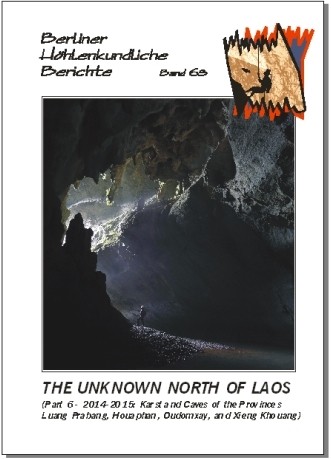
M. Laumanns (Ed.): The Unknown North of Laos. (Part 6 - 2014-2015: Karst and Caves of the Provinces Luang Prabang, Houaphan, Oudomxay and Xieng Khouang). 115 pp., colour photo tables, many maps & surveys; Berlin 2016. This volume presents the results of the 2014 and 2015 international expeditions to Northern Laos and describes a total of 23 km of passages from 70 caves. Includes the Tham Houay Ngot-Pang Ngoy System (3,620 m long) and Tham Lo (2,103 m), both in Houaphan, as well as Tham Nam Lod (1,796 m long) from Luang Prabang province. In English with German and French abstracts.
A beautifully hand crafted holiday stocking hand made in the mountains of Peru. Depicts a farm scene with cows, a house, caves and bats with mountains in the distance. Fair trade goods made employing local artisans in traditional designs, made exclusively for Speleobooks. Twelve by eight inches. Suitable for wall hanging or holiday display.
Herbert Daniel Gebauer. 300 pp., colour photo tables, colour area maps and many surveys; Berlin 2015
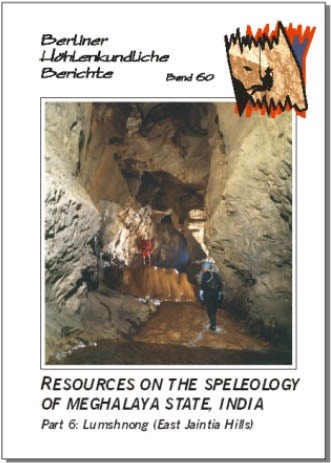
An enormous collection of cave descriptions, cave surveys, location maps and references on this major caving area in Meghalya. Descibes 222 underground sites, including Krem Kosati (18,871 m), Synrang Pamiang (14,113 m), and Krem Umsynrang (5,573 m). Also features the first image ever published from the Cloud of the Abodes!! In English.
Francois Brouquisse, Louis Deharveng & Michael Laumanns. 208 pp., colour photo tables, numerous area maps and cave surveys; Berlin 2015.
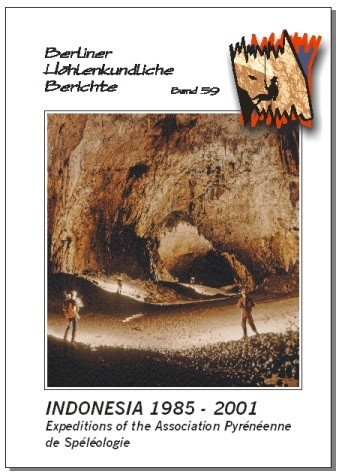
Expedition-style speleological exploration of Indonesia was started on Sumatra in 1977 by a Spanish team from the GESM Barcelona, when they visited western Sumatra. However, most knowledge on the karst of Indonesia was gathered by the French "Association Pyreneenne de Speleologie (APS)", who started exploration in the Maros karst of Sulawesi in 1985 and returned to Indonesia on an almost annual basis until 2001 and visited many karst areas all over the archipelago, often together with Indonesian speleologists. They released excellent reports with many detailed cave surveys and in-depth biospeleological data, all of which are presented in this publication for the first time in English language. Extensive karstological data (morphology, hydrology, water chemistry, climatology...) were also gathered during those 15 years. These scientific results were included in the APS caving reports as well as in specialized publications. The longest caves known in Indonesia is Luwang Jaran (Java, Gunung Sewu) at 18,200 m. Many of the other long Indonesian caves were explored by APS, such as Gua Salukkan Kallang (Sulawesi Selatan, Maros, Kappang) at 12,263 m, Leang Assuloang at 10,400 m (Sulawesi Selatan, Maros, Pangkadjene), Gua Tanette (Sulawesi Selatan, Maros, Kappang) at 9,692 m, and Gua Batu Lubang (Halmahera) at 8,685 m. Also many of the deepest caves known in Indonesia were surveyed by APS. In English.
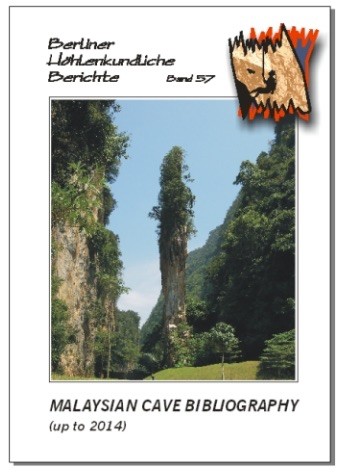
267 pp., colour photo tables; Berlin 2015. Edited by Liz Price. This bibliography covers the whole of Malaysia, i.e. Peninsula, Sabah and Sarawak, and contains almost 5,200 entries on Malaysian caves and karst, dating from the 1700s to 2014. In addition there is an extensive newspaper biblio covering 1953-2014. Other pages provide an introduction to Malaysian caves and history, and there is a map and glossary. An invaluable reference work for anyone interested in limestone caves and karst, archaeology, conservation, flora and fauna, geomorphology, geology, hydrology, history etc., as well as for the sporting caver who wants to learn more about Malaysian caves. In English.
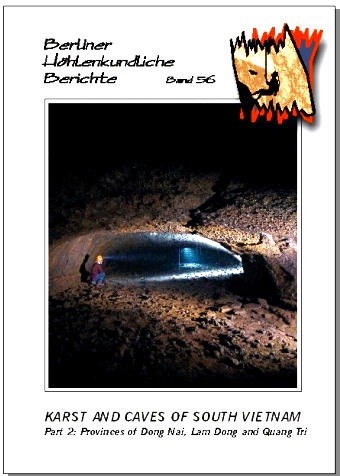
49 pp., colour photo tables, area maps and many surveys; Berlin 2014 The famous volcanic caves of Dong Nai province are presented in this volume in detail, including the new longest lava tube cave known in Southeast Asia. The 35 caves described have high biospeleological relevance. Furthermore five caves formed in granite boulder from the neighbouring Lam Dong province are included as well as a short note on caves in Quang Tri province. In English.
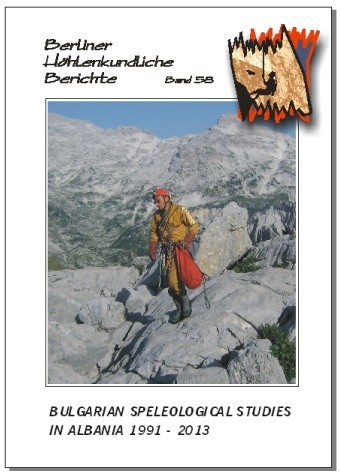
Alexey Zhalov (editor). 105 pp., numerous colour maps, cave surveys and photo tables; Berlin 2015 Beside scientific studies on the geosettings, tectonics, cave climatology, and biospeleology as well as an overview about the history of cave exploration in Albania this volume presents the 52 most important caves of the Albanian Alps. This includes the four deepest caves currently known in the country: Shpella BB-30 (-610 m), Shpella Ru (-580 m), Shpella e Celikokave (-505 m), and Maya Arapit Cave at 431 m (+363/-50 m). The volume also has extensive cave lists and an in-depth bibliography. In English.
Cavers to the Core / Horne Lake Hornpipe (4:28) - a reminder from the band that music isn't everything - we're serious cavers too!
Bangin' Bill (3:26) - a musical tribute to that controversial figure - the micro-blaster! Cave softly ....................................
The Caver's Prayer* (3:39) - you don't have to be religious to endorse this one!! What every caver really wants ...........................
The Ballad of Dangerous Dick** (4:00) - at last! Some "real" information about Dangerous Dick and his crazy crew! The Codgers Caving Club (3:46) - what do cavers do when they get old?!? Find out right here!!
The Cavernous Crawl (4:32) - one way of passing the dog-days of winter when the streamways and the caver's thirst both run high together! A "Shaw" Thing (3:30) - a tribute to our mate Pat Shaw, man of many talents! It's all true, folks - would we lie to you?!?
Karst Fever (4:21) - the album title track, and a grim warning about the dread disease to which all cavers are highly susceptible. Dangerous Dick knows the cure!!
The Parys Mountain Mine / Knocker's Reel (5:55) - a tribute to Dick's mine-exploring mates in the Parys Underground Group in Anglesey, North Wales.
Don'cha Meddle with The Mole! (3:32) - advice for the "call me when it goes" crowd who hate digging!
This Old Caving Helmet of Mine (5:57) - even hardened cavers wax sentimental on occasion ........................
Frozen at the Top of the Drop (3:39) - every rookie caver's worst nightmare!
The Caver's Alphabet (2:20) - forget the text-books! Here's caving from A to Z in one supremely silly song!!
Time ta Quit Cavin' when the Lights go Out (3:32) - some very sound (and quite loud!) advice from the band on the subject of caving safely!!
Cavers to the Core (reprise) / The Winds of Weymer (7:52) - thanks for listening, and a promise from the band.. we leave you with a serious musical tribute to one of our favourite caving areas.
All selections written by Adrian C. Duncan except * traditional, new lyrics by Adrian C. Duncan and ** written by Adam La Rusic and Adrian C. Duncan.
Before 1929 Howe Caverns was known as Howe’s Cave. Lester Howe discovered the cave on May 22, 1842. After digging open the entrance, he started giving tours. Those early tourists have left behind tales of their adventures underground. At times thrilling and even funny, these contemporary accounts along with current introductions and biographies give a history of the cave and the events of the times. Howe’s Cave was favorably compared to Mammoth Cave in Kentucky and many writers described it as rivaling it in size and grandeur. Thom Engel has unearthed these tales and descriptions and has brought them together in one place: To Rival Mammoth Cave. 254pp. Soft bound.
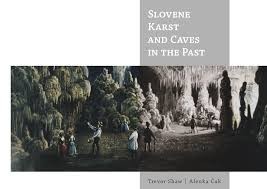
The caves and dramatic limestone scenery of the Slovene karst have attracted visitors for centuries. The great stalagmites and roaring underground rivers were seen by relatively few people at that time but many of them did record their experiences in diaries as well as in print. These are used in the book, which is a result of a long-time collaboration between an English historian of speleology and a Slovene historian, to describe what they saw and what they thought about it, with contemporary illustrations by contemporary artists and photographers. Modern tourism derives from the tours led by Thomas Cook who first came to Postojnska jama in 1868. Music in that cave has a very long history for dancing or concerts. This is only one example of the relation between caves and people as a constant theme in this book. Altogether the 39 chapters describe, for example, the problems facing all travellers in pre-railway days and point out that one of the very first women to explore difficult caves did so at Skocjan. Also touched upon is Darwin's interest in Slovene cave animals and a lot more.
By Bert Ashbrook. 2013, 116 pages. Describes Pennsylvania cave references written during the 18th century, and about the people who recorded and wrote about those caves. Includes maps and engravings.
2012, Mark Aldler, Editor. Covers descriptions of regional caving organizations, regional geology and cave sciences, plus cave descriptions for Greenbrier and Monroe counties. 254 pp., sb.
"Somewhere In The Depth There Exists A Light: A Story About The Secrets of Caves" By Andreas Pflitsch and Dirk Steinhofel. A 10 by 13 inch story book in German spectacularly and ingeniously illustrated with drawings, photographs and many other small details creating the look of a hand made scrapbook following the story of an underground scientific mystery deep in the chambers and halls of a mile long cave system. A fictional story about cave explorer Elias Hope, his special knowledge and a secret that he could never understand. For his great-grandchildren Jonas and Sophi a visit leads to a clear understanding..with their great-grand father they will solve the puzzle. HB, 2014, 49pp.
Die beiden Geschwister Jonas und Sophie besuchen ihren Urgrossvater Elias in den USA. Der kauzige alte Mann ist Hohlenforscher und weiss alles uber Hohlen: wie sie entstehen, warum Tropfsteine wachsen und welche Schatze die unterirdischen Welten bergen. Doch es gibt ein Phanomen, das Elias sein Leben lang nicht ergrunden konnte: Ein geheimnisvolles Licht, tief in einer Eishohle. Fur Jonas und Sophie ist klar - gemeinsam mit ihrem Urgrossvater werden sie das Ratsel der Eishohle losen. Die perfekte Mischung aus Abenteuer und Wissen liefern der Illustrator Dirk Steinhofel und der Hohlenforscher Andreas Pflitsch in diesem besonderen Sachbuch. Willkommen in den Tiefen der Erde!
This title explores the underground caves, sinkholes and underground rivers of Jamaica. Alan Fincham Press University of the West Indies, 1997 - History - 447 pages. With specialist chapters contributed by: Grenville Draper, Ronald Read, Donald McFarlane, Ross MacPhee, Stuart Peck and Trevor Shaw.
A beautiful box of New York Times best-selling Bats books. Includes three captivating stories about the nighttime exploits of a crew of nocturnal adventurers--Bats at the Beach, Bats at the Library, and Bats at the Ballgame. With gorgeous illustrations to pore over and lyrical, rhyming text to read aloud, these books are made for repeat performances. 6 1/2 by 8 1/2 inch hard bound books. Includes a sheet of stickers.
By Culver and Pippin. 2014, 288 PP. Hardcover. Shallow subterranean habitats (SSHs) are areas of habitable space that are less than 10 m in depth from the surface. These range from large areas such as shallow caves and lava tubes, to tiny areas such as cracks in ceilings, or spaces in soil. Whilst being very different in many ways, they are often bound together by shared characteristics of the habitats and their faunas, and their study can help us to understand subterranean habitats in general. This book concentrates on the more typical SSHs of intermediate size (seepage springs, spaces between rocks, cracks in lava etc.), describing the habitats, their fauna, and the ecological and evolutionary questions posed. Similarities and differences between the habitats are considered and discussed in a broader ecological and evolutionary context. The book is mainly aimed at students and researchers in the field of subterranean biology, but will also be of interest to a wider range of ecologists, evolutionary biologists, freshwater biologists, and conservationists. There will also be an audience of environmental professionals.
Two powerful symbols of intuition, wisdom, and sensitivity come together in this Bronze Moon Necklace with Bats on Gold Fill Chain. Due to their keen senses, bats symbolize intuition, dreams, and visions. The luminous bronze moon shined to perfection provides a striking contrast to shiny silver bats. The bronze is a high quality Italian alloy of copper and tin that contains an anti-tarnish compound which delays, but does not eliminate, eventual oxidation. Comes on a simple gold fill 18" cable chain with spring ring clasp. Bronze Moon Necklace with Bats charm measures 24x18mm, excluding jumpring. · Made from Recycled Sterling Silver. 16 inch chain. 7/8 Inch moon.
Flying in for friendly fun is the Folkmanis Fruit Bat. Also known as a flying fox, this winged wonder has a cute, foxlike face with short snout and pointy ears as well as movable wings that span 20" wide.
Immerse yourself in the rustic charm of our Bat Magnet by Universal Ironworks Inc. This 4-inch magnet, intricately cut from American-made steel, captures the uniqueness of their rusting process carried out in Prescott Arizona. Ideal for adding a touch of nature-inspired aesthetic to your space, it's more than just a magnet, it's a piece of art.
Due to their keen senses, bats symbolize intuition, dreams, and visions to many cultures. Bats are very nurturing, exhibit verbal communication, touching, and sensitivity to members of their group.
Due to their keen senses, bats symbolize intuition, dreams, and visions to many cultures. Bats are very nurturing, exhibit verbal communication, touching, and sensitivity to members of their group.
A Victorian design gives these earringas a classic look. *Nickel-free bronze ear wires and backs. *Dangle Earrings are about .75" by 1.5" with accent bead. *Image area 5/8" (16mm about the size of a dime). *Earrings arrive carded inside a chipboard gift box.